
how to stop dog from chasing cats usually comes down to two things: managing the situation so nobody gets hurt, and teaching your dog a different habit that works even when a cat darts across the room.
If you live with both animals, you already know the frustrating part, you can do “good training” for weeks and one surprise sprint resets everything. That’s not you failing, it’s prey drive plus rehearsal. The more the dog practices chasing, the more automatic it becomes.
This guide stays practical: what to do today to prevent another chase, how to train a reliable “leave it/come” around cats, and when it’s smarter to bring in a qualified professional.
Why dogs chase cats (and why it’s not always aggression)
Chasing is often predatory behavior, not “being mean.” Many dogs get a dopamine hit from movement, the cat runs, the dog chases, and the loop rewards itself.
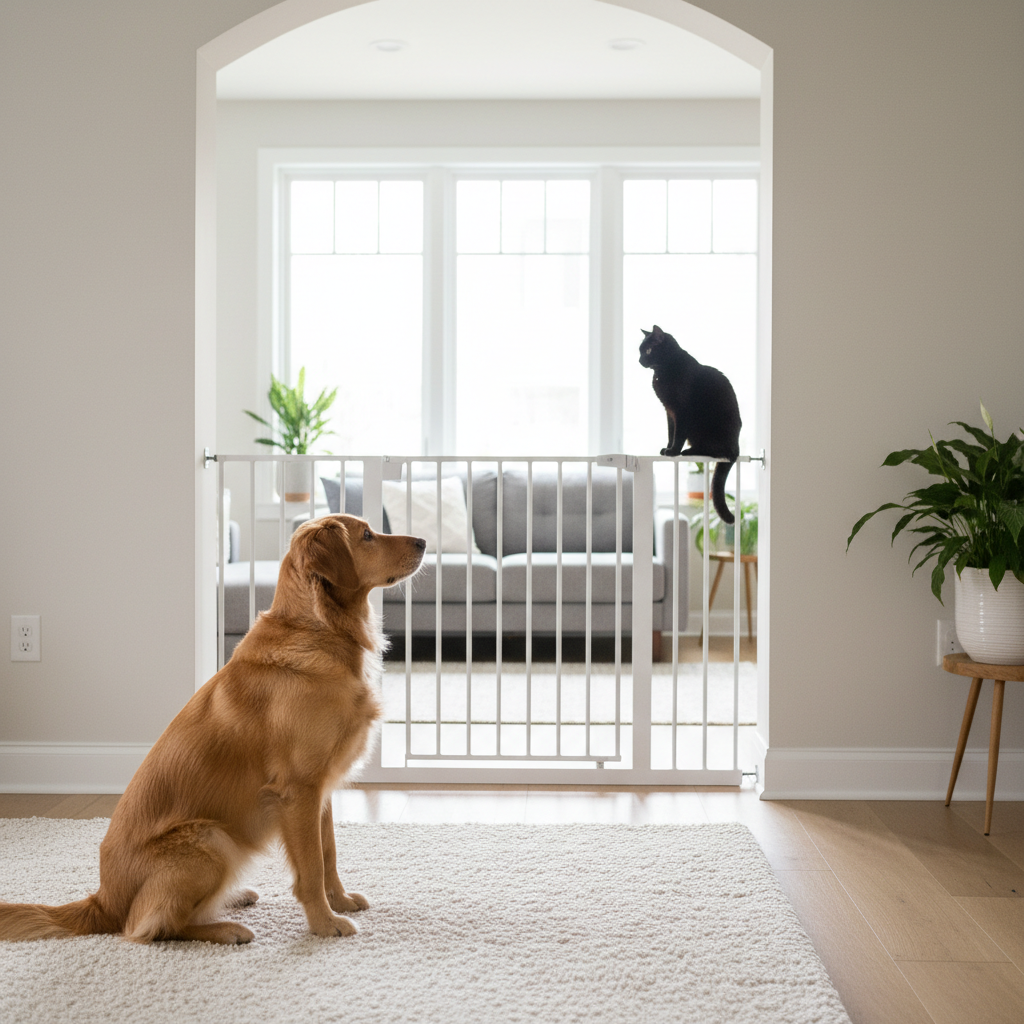
A few common drivers that look similar but need different handling:
- Prey drive: the dog locks in, body gets still, then bursts into chase when the cat moves.
- Over-arousal: the dog gets loud, bouncy, mouthy, and can’t “hear you” once excited.
- Herding instinct: some dogs try to control the cat’s movement, circling or cutting off paths.
- Fear-based reactivity: the dog barks or lunges because the cat feels unpredictable or threatening.
According to the American Veterinary Medical Association (AVMA), preventing dog bites and inter-animal conflict often depends on supervision, safe separation when needed, and early intervention before patterns become routine.
Quick safety setup: stop the rehearsal before you train
If chasing keeps happening, training progress stays fragile. Your first win is making it hard to practice the chase while you teach new skills.
- Use physical barriers: tall baby gates, cat doors, exercise pens, or closed doors during high-energy times.
- Create “cat-only” zones: vertical space, shelves, a room with a gated entry, and multiple escape routes.
- Leash indoors temporarily: a drag line can help you interrupt safely without grabbing collars.
- Manage high-risk moments: feeding time, door greetings, zoomies, and evenings when everyone is wired.
One detail people miss: if the cat feels trapped, it may swat or bolt, and that movement can flip the dog into chase mode. Give the cat exits first, then work on the dog’s behavior.
Self-check: are you dealing with “training issue” or “red flag” risk?
Before you push training intensity, get clear about what you’re seeing. Use this quick checklist.
Signs the dog may be trainable with standard plan
- The dog can take treats and respond to your voice at a distance from the cat.
- The dog can disengage when you call them, even if it takes a moment.
- Chasing happens mainly when the cat runs, not when the cat is still.
Signs you should slow down and consider professional help
- Stalking (stiff posture, silent fixation) followed by sudden lunging.
- Grabbing, pinning, shaking, or repeated attempts to bite.
- The dog cannot disengage even with high-value food, distance, or barriers.
- The cat shows severe stress: hiding constantly, not using the litter box, not eating.
If any red flags show up, management becomes your main safety tool, and training should be guided by a qualified professional.
Training foundation: teach “disengage” before you test around a running cat
To how to stop dog from chasing cats in real homes, you usually need impulse control and a clean “turn away from the trigger” habit. Start where your dog can succeed.

Step 1: Build a strong “Look at me” (attention cue)
- Say the cue once, reward the instant the dog makes eye contact.
- Practice in low-distraction rooms, then near a window, then near the gate where the cat might appear.
Step 2: “Leave it” for movement, not just food
- Start with a treat in your closed hand, reward when the dog stops trying.
- Progress to a tossed treat the dog must ignore until released.
- Only then apply it around the cat at a safe distance, with the cat stationary.
Step 3: Mat training (settle on cue)
- Reward for stepping onto a mat, then for lying down, then for staying while you move.
- This becomes your “default behavior” when the cat enters the room.
According to the American Kennel Club (AKC), rewarding calm behaviors and teaching reliable cues through positive reinforcement can improve responsiveness and reduce unwanted chasing in many everyday scenarios.
Controlled cat introductions: a step-by-step plan that doesn’t rely on luck
Most setbacks happen because people jump straight to “let’s see what happens.” Instead, run short, controlled sessions where you can keep everyone under threshold.
- Stage 1 (separated): dog on leash, cat behind a gate, reward the dog for calm and for looking away.
- Stage 2 (same room, distance): keep the dog leashed, let the cat choose where to be, reward disengagement and mat settles.
- Stage 3 (brief movement): use a toy to create small cat movements only if the dog stays responsive, end early on a win.
- Stage 4 (supervised freedom): only after many calm reps, try short off-leash time with cat escape routes and a drag line ready.
Session rule that helps: quit while your dog still looks “boring.” If you wait for excitement, you waited too long.
What to do in the moment when the chase starts
Even with good training, life happens. Your goal in the moment is to interrupt without adding chaos.
- Don’t run after them: it can turn into a game and increase speed.
- Use a trained cue: “come,” “touch,” or “mat,” then pay with high-value treats.
- Create a barrier: step behind a gate, close a door, or use an exercise pen panel.
- Use sound thoughtfully: a calm clap or “hey” can work, but avoid screaming which often adds arousal.
If your dog grabs the cat, avoid reaching near the mouth. This is where professional guidance matters, because safety techniques can vary by size and risk.
Common mistakes that keep the chasing alive
Some approaches feel logical, but often backfire in real homes.
- Punishing after the chase: the dog learns “cat predicts scary human,” not “don’t chase.”
- Testing too soon: going off-leash before you have reliable responses on leash.
- Only training when the cat appears: skills need reps when nothing exciting happens.
- Assuming the cat will ‘teach the dog’: a swat might stop one approach, but it can also trigger chase.
Also, if the dog is under-exercised or under-stimulated, chasing becomes a self-made sport. That doesn’t excuse the behavior, it just explains why it’s sticky.
A simple plan by scenario (with a quick table)
Different homes need different priorities. Use this as a starting point, then adjust based on what you see.
| Situation | Primary goal | What to do this week |
|---|---|---|
| Dog chases only when cat runs | Impulse control + management | Gate setup, mat training, reward disengagement, short controlled sessions |
| Dog fixates, stalks, ignores food | Safety + professional plan | Strict separation, muzzle training if advised, consult a certified trainer/behaviorist |
| Dog gets overexcited at certain times | Lower arousal | Predictable routine, enrichment toys, leashed transitions, calm reinforcement |
| New cat or new dog in the home | Slow introduction | Scent swaps, barrier sessions, gradual exposure, avoid “free-for-all” meetings |

Key takeaways: manage access, reward calm choices, train cues away from the cat first, and only increase difficulty when you consistently win at the current level.
When to involve a professional (and what to look for)
If you’re worried about injury risk, or the dog shows intense predatory behavior, it’s reasonable to seek help early. According to the American College of Veterinary Behaviorists (ACVB), behavior problems can have multiple drivers and may benefit from individualized assessment, and in some cases a veterinarian may discuss medical factors or supportive options.
- Look for a trainer who uses reward-based methods and can explain their plan in plain language.
- Ask how they handle cat safety, home setup, and progression criteria.
- If bites or near-bites occurred, consider a consult with a board-certified veterinary behaviorist.
There’s no shame in this step. Many households get unstuck faster with a skilled eye, especially when timing and distance matter.
Conclusion: make chasing hard, calm easy, and progress predictable
how to stop dog from chasing cats is rarely one trick, it’s a small system: barriers to prevent practice, a handful of trained cues, and gradual exposure that keeps your dog under their excitement threshold.
If you want a simple next move, pick one management change you can keep for two weeks, then run daily 3–5 minute sessions on attention, “leave it,” and mat settles. The combination tends to beat willpower every time.
If you’re still seeing fixation or your cat seems stressed, consider scheduling a consult with a qualified trainer or veterinary behavior professional so you’re not guessing on safety.
FAQ
- Can I train my dog to ignore my cat completely?
Many dogs can learn to disengage and coexist peacefully, but “completely ignore” varies by breed traits and prey drive, so aim for calm responses and reliable cues. - Is it okay to let my cat swat my dog to set boundaries?
Sometimes it reduces pushing behaviors, but it can also trigger chase or escalate stress, so it’s safer to use barriers and controlled training instead of relying on corrections from the cat. - What if my dog only chases when I’m not watching?
That usually means management is the missing piece, use gates, closed doors, and supervised time until the dog’s habits shift. - Do shock collars stop chasing cats?
They may suppress behavior in the moment, but they can increase fear or arousal and make the cat a negative trigger, a reward-based plan is typically safer and more predictable. - How long does it take to stop a dog from chasing cats?
It depends on intensity, how often chasing has been practiced, and how consistent your setup is, many households see change in weeks, reliability often takes longer. - Should I muzzle-train my dog around cats?
In higher-risk cases, a properly fitted basket muzzle can add safety while you train, but it should be introduced gradually and ideally with professional guidance. - What if my cat keeps running and triggering the dog?
Improve cat escape routes and vertical space, then train the dog’s settle and disengagement at a distance so the cat doesn’t feel forced to bolt.
If you’re dealing with daily chases and want a more streamlined plan, consider working with a reward-based trainer who can map out distances, barriers, and progression criteria for your specific home layout and pets.